

Employability Skills
Employability skills are the non-technical skills that support career success such as intrapersonal skills that support goal-setting, continual learning, and sustained engagement on tasks; interpersonal/teamwork skills that support productive interactions with others and flexible adaptation to workplace organizational roles and structures; and applied competence to solve problems and think critically.
THE FIVE HIGH-PRIORITY EMPLOYABILITY SKILLS
There were five high-priority employability skills that were emphasized in our interview data and the research literature.
- 1. Interpersonal/Teamwork Skills
- 2. Communication Skills
- 3. Orientation to lifelong learning
- 4. Adapting to workplace expectations
- 5. Situational Awareness
These skills are mutually reinforcing and complementary. For example, the personal quality of work ethic, which includes elements of reliability and conscientiousness, is often mentioned as a foundational component of teamwork and collaboration. The personal quality of work ethic, which also includes elements of persistence, complements the personal quality of willingness to learn as well as problem-solving. Further, differences between the contexts and rituals of the two different technician fields studied affect some of the field-specific expectations for each of these competencies.
Workplace Diversity Skills
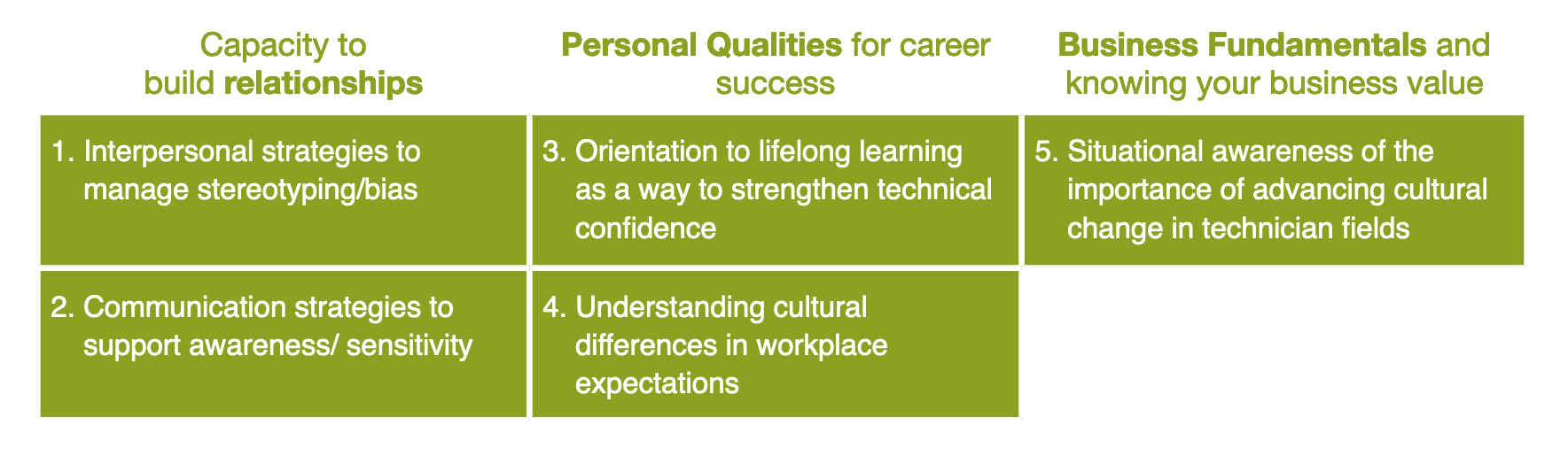
Educators and employers described the need to provide more targeted strategies to prepare underrepresented technicians for the experiences they will face. Based on these findings, the research team tailored the employability skills (see table below) and reframed how the learning principles and the developmental model can support targeted diversity coaching. To help designers of diversity coaching programs, a February 26, 2020 webinar presents the overall approach along with two exemplar programs. A link to the webinar recording will be posted here along with a set of additional materials from ATE programs by March 31, 2020.
The five focused essential employability skills supporting historically underrepresented populations in technician fields